In each of the lessons, you can click on this top logo to go to the index of lessons
Lesson 6 Practice: Chord Types
.
In Lesson 6, we went beyond major chords and started to learn about some
of the other chord types (triad qualities). This practice exercise goes
through each of the different keys and each of the four chord types -
major, minor, diminished and augmented.
.
If your piano is in a place where you can't look at the computer screen
while you're playing along, you can click on the "Worksheets" button to
the left and that will let you view and print out a one-page worksheet
that contains all the practice exercises we'll be doing in this Lesson.
Even if you do have your keyboard and your computer right next to each
other, you may find it useful to print this page.
.
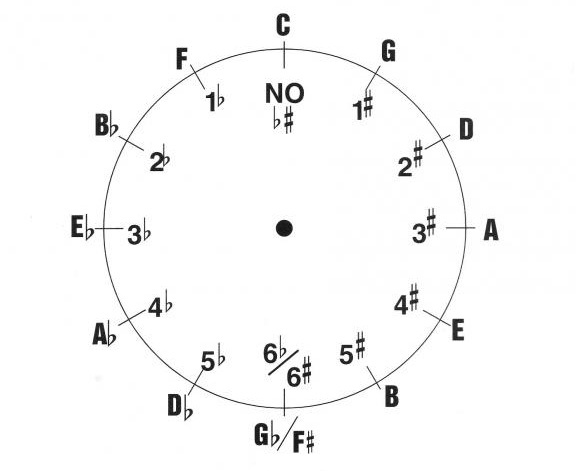
We won't be learning about the "Circle of Fifths" until Lesson 7, but
it is a tool that puts the chords in order by the number of sharps (or
flats) in the key signature. In these practice exercises, we move
from the easiest key - C - to one of the most difficult keys (Db -
five flats). You may find it helps if you open this version of the
Circle of Fifths (it will come up in another window) and work through
the different keys by working your way around the Circle - C, G, D,
A and so on in the "sharp keys," and C, F, Bb, Eb and so on in the
"flat keys." The key of G just has one sharp, so the chord types
in the key of G are going to be almost as easy as the ones in C.
.
In Lesson 7, I have included an interactive "tool" based on the Circle of Fifths, but
we're not quite ready for that yet. We'll get there!
.
.
P1T26
.
This clip provides a quick introduction to this unit. The "Triad
Quality Chart" I refer to is the Worksheet you can view and print by
clicking the "Worksheets" button above.
.
.
P1T27
.
In each of these short clips, I just play through the four variations
of the chord. Repeat each clip until you are able to play along with
me at the speed I am playing. We start out in the key of C:
.
.
.
P1T28
.
We now move up a half step to the key of Db. As I said in the introduction
to this Lesson, Db is one of the toughest keys to play, especially once
we start getting into notes with "double flats." You may find it easier
to open the interactive
Circle of Fifths tool
(it will come up in a separate tab
or window) and work around the circle in one direction or the other, so
that you're not immediately jumping to such a difficult key!
.
.
.
P1T29
.
Here are the chord types in the key of D - two sharps.
.
.
.
P1T30
.
Here are the chord types in the key of Eb - three flats.
.
.
.
P1T31
.
Here are the chord types in the key of E - four sharps.
.
.
.
P1T32
.
Here are the chord types in the key of F - one flat.
.
.
.
P1T33
.
Here are the chord types in the key of F# - six sharps. As you can
see, we start getting into "double sharps" in the augmented chord -
C## is just two steps to the right of the C chord - so it's the D key
by another name. We just don't call it the "D" key because "D#" is
one of the notes in the F# scale - and then we'd have two "D" notes
and no "C" notes.
.
.
.
P1T34
.
Here are the chord types in the key of Gb - six flats. The notes you
will play are on the same KEYS as the chords in F# - they are just all
called by different names. This may seem pointless, but when you are
playing "by ear," there are times when you will want to think of
these chords as variations of "F#" and times when you will want to
think of them as "Gb". For example - if you are playing in the key of
"A", "F#m" will be a chord you run into frequently, and since "A" is
a "sharp" key, you won't want to suddenly have to start thinking in
"flats" in the middle of a song. On the other hand, if you're playing
in the key of Ab, you will want to think of this as a "Gb" chord, not
an "F#" chord.
.
.
Stop and compare the Gb chords with the F# chords again - remember we
said that the C## note is played on the "D" key? Look at the last key
of the Gb Augmented chord - it's a "D" note, even though it's called a
C## in the key of F#. If we're playing a song in the key of Gb, we
don't want to have to figure out what key a C## is - we're thinking
"flats." On the other hand, in the key of Gb, we get Bbb and Dbb
notes in some of the chords. If some of this seems strange now, just
trust me - it's better to learn it this way than to have to re-learn
things later!
.
.
P1T35
.
Here are the chord types in the key of G, one of the easiest keys to play.
.
.
.
P1T36
.
Here are the chord types in the key of Ab - four flats.
.
.
.
P1T37
.
Here are the chord types in the key of A - three sharps.
.
.
.
P1T38
.
Here are the chord types in the key of Bb - two flats.
.
.
Notice that in this example, the Augmented chord includes an "F#" note,
even after all we've been talking about not using "sharp" notes in
"flat" keys. The reason I did this is that the "augmented" chord is
made by raising the 5 note by half a step, and in the key of Bb, the
5 note is an F. So we could have called it a Gb, but then we're not
thinking in terms of "raising the fifth" anymore.
.
Well, the Bb chord was already one of our "oddball" chords, wasn't
it? I'm afraid this is just one more way the Bb chord is... a
little bit odd.
.
Actually, you probably noticed that a number of the chords in "sharp"
keys included a "flat" note here and there. The explanation is the
same - when we're making a minor, diminished or augmented chord, we
are doing so by raising or lowering one of the notes in the chord by
a half step, and sometimes that makes the notation look a little...
odd...
.
.
P1T39
.
Here are the chord types in the key of B - five sharps. In this case,
we lower a lot of the notes to make most of the chords - but since
those notes are already "sharped," we don't have to call them "flat"
notes.
.
.
.
Hooray, You Made It Through Lesson 6 Practice !!!
I'm sure it took you a while to play through all these exercises,
especially the ones that had lots of flats or sharps in the key
signatures. Congratulations on making it through - just know that
when you're actually playing along with other musicians, you are
going to need to know these different chord types to play songs.
They are also going to be very important when we get to the
Lesson on "Chord Substitution." As always... if you have questions
or noticed a problem with any of these exercises, please click on
the "Ask Rhonda" button and let me know. If you do have a question,
I'll try to get back to you with an answer as quickly as I can!

 Lesson 6 Practice: Chord Types