In each of the lessons, you can click on this top logo to go to the index of lessons
Lesson 11: Accompaniment
.
So far, most of what we've been playing with our left hand is pretty simple -
play a chord and hold it for four beats, or play it in "broken" style, one note
at a time. In this lesson, we will look at some of the more interesting ways
we can play the left hand part.
.
The part we've been playing with the right hand so far is the "melody" of the song.
The left hand has been playing along with the melody, or "accompanying" the melody.
This is why we call it the "accompaniment." Eventually, you may be playing along
with a singer or another instrument that plays the melody, and you'll be able
to use both hands to accompany them - but for now, let's just look at what
you can do with the left hand.
.
We will continue to work in our teaching key of "C", but when you have time,
try to practice these exercises in other keys.
.
If you decide you would like to view the "Circle of Fifths" tool for this lesson,
you can come here, to the top of the page, at any time and click this button to
open it - again, it will open in a new tab or window.
.
.
RM245
.
Play this clip to hear an introduction to our lesson on playing an
accompaniment to a song.
.
.
RM246
.
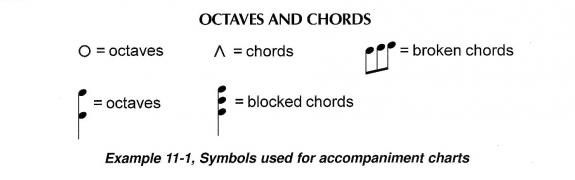
Let's go over a couple of "terminology" things that I'm going to use
in this lesson - symbols for "octaves" and "chords".
.
.
.
.
RM247
.
Play the audio clip to hear the difference between blocked and stacked chords and
octaves. We also combine octaves and blocked chords in the left hand to "dress up"
our accompaniment a little bit.
.
.
.
RM248
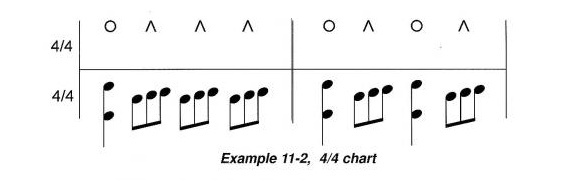
Follow along as I show you a couple different ways of combining "octave"
sounds with "broken chords."
.
.
.
.
RM249
.
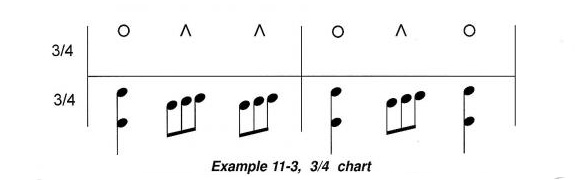
This example is similar to what we did in some of the previous examples,
but here's we're playing in 3/4 time rather than 4/4 time.
.
.
.
RM250
.
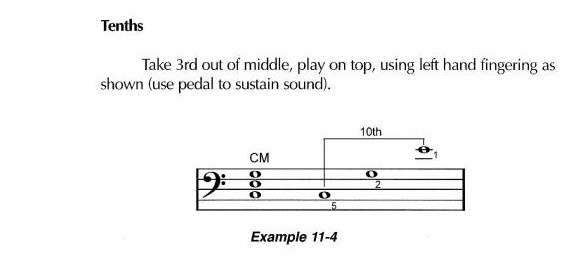
Here's another way of playing chords: "tenths":
.
.
.
RM251
.
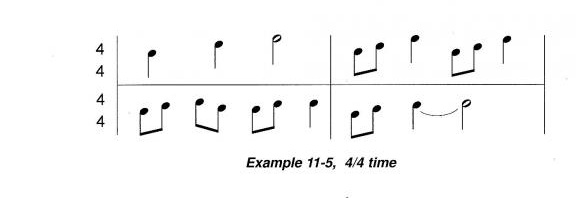
Here's another way to play chords - here's yet another way to play chords
in rhythm. Just in case it's not clear - each of the four measures you see
is played separately - first the upper left, then the upper right, then the
lower left, then the lower right.
.
.
.
RM252
.
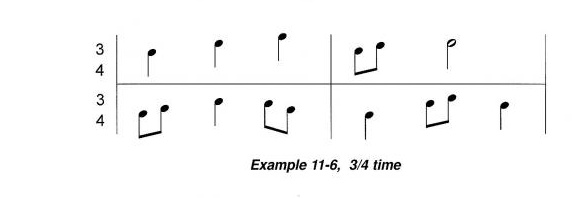
Here is a similar example, but in 3/4 rather than 4/4. Again, there are four
separate measures here - upper left, upper right, lower left, lower right.
.
.
.
We played through all the exercises in this lesson in our teaching key, "C". For practice on
your own, try playing through these exercises in other keys.
.
As you get into the keys with more sharps or flats, some of the notes you
play will fall on black keys, so it's good to practice playing in these other keys.
.
.
Hooray, You Made It Through Lesson 11 !!!
uess what - just one more lesson after this one and we're finished with the course!
If anything in this lesson - or any of the previous lessons - is not clear to you,
click on the "Ask Rhonda" button to send me an email to ask your question. In the
final lesson, we put everything together, so if there's anything you're not sure of,
now is the time to ask!

 Lesson 11: Accompaniment