In each of the lessons, you can click on this top logo to go to the index of lessons
Lesson 6: Chord Types
So far in this course, we have learned about the notes on the major scale, and how
those notes go together to form major chords (or major triads). We briefly discussed
the other triad qualities: minor, diminished and augmented. In this lesson,
we will look at these other triad qualities in more detail, and learn to play
these different types of chords on the piano.
.
.
RM185
.
Play this audio clip to begin learning about chord qualities. To play these chords,
we need to know how to play the major chord - which we learned in the last lesson -
and then how we alter the third and/or fifth tones to make the other chord qualities.
.
.
RM186
.
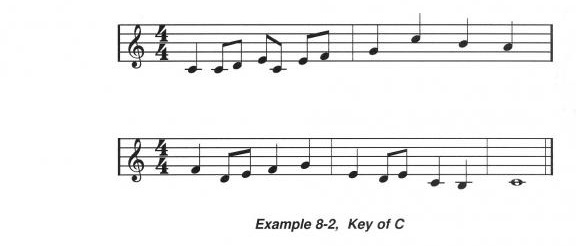
Here is a tune I've written that will become a theme for the rest of this course. As we
work on learning to harmonize music (add chords), we will use this tune frequently.
.
.
.
RM187
.
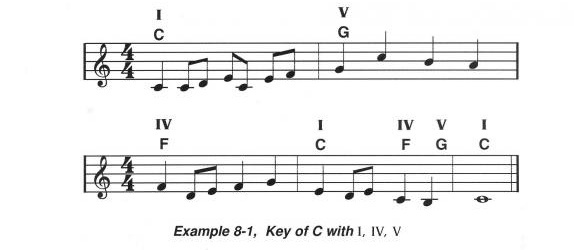
Above the tune, you will see two different types of notations: the chord symbols (C, F, G)
and the Roman numeral equivalents. While I play the melody, you play the chords as written.
.
.
.
RM188
.
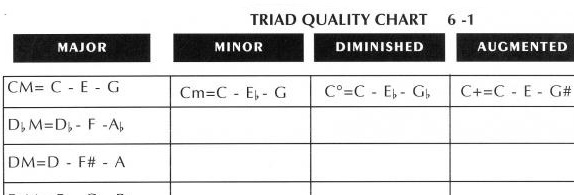
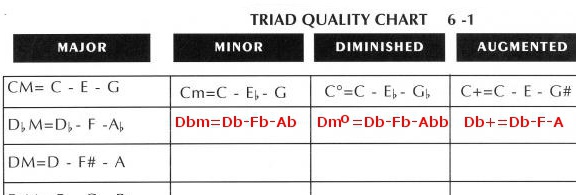
The "Triad Quality Chart" expands on work that we did earlier; for each triad,
we now add in the information about the minor, diminished and augmented triads in
the same key. Click on the "Worksheets" button below to view the whole Triad
Quality Chart; you should print a copy to write on as we go through this lesson.
.
The first couple lines of this chart look like this:
.
.
Click the "Worksheets" button to view and print out the whole Triad Quality Chart
worksheet. As we continue through this lesson, you will fill in all the spaces in
this chart.
.
.
RM189
.
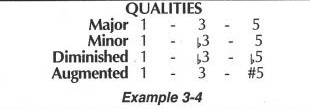
To review, here are the changes to each chord that change the quality of a chord from a major
chord to a minor, diminished or augmented chord:
.
.
.
RM190
.
Let's review how to create the four different triad qualities, starting with the
C Major chord.
.
.
.
RM191
.
Let's work through a couple of the rows on the Triad Quality Chart to make sure
you know how to fill out the chart. To view the chord substitution chart mentioned
in the narration, click
here
.
.
RM192
.
So we'll start out by going through the C Triads - they're already filled out, but
this will help explain why the notes that are there... are there.
.
.
.
RM193
.
So now, let's take a look at the Db row, the second row in the table, and see how
that one gets filled in... there will be a couple of unusual things in these chords,
like F-flat and A-double-flat. We describe the notes this way so that we obey
the rule that the note names don't change - each of the Db triads conains a Db, an
F (something) and an A (something).
.
.
.
RM194
.
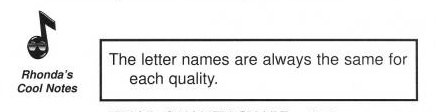
As we just said -the note names stay the same through all the triads, even if this
requires double-flat or double-sharp notation.
.
.
.
RM195
.
The "Answers" link below takes you to the completed "Triad Qualities"
worksheet I mention in the audio clip.
.
Click the "Answers" button to view and print a completed copy of the Triad Quality Chart.
.
.
RM196
.
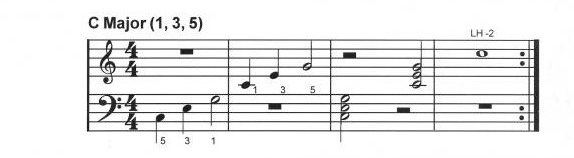
Now that we've worked out what notes make up each chord quality for a particular root note let's
see if we can PLAY the notes for all four qualities of the C chord.
.
First, the major chord. Let's play the chord song in C Major:
.
.
.
RM197
.
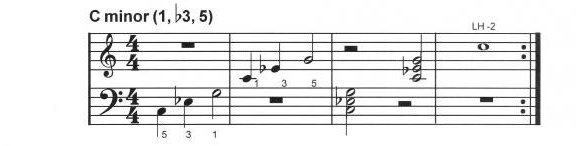
...and then we play the minor version:
.
.
.
RM198
.
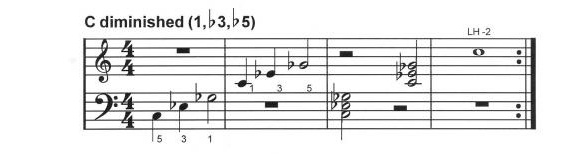
...and the diminished version:
.
.
.
RM199
.
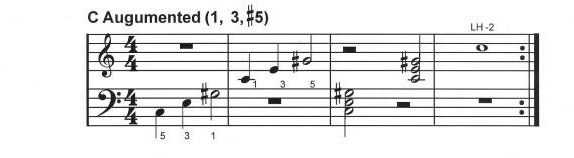
And finally the augmented version. Before you go on, try to play the chord songs
for some of the other chords that you filled in on the Triad Quality Chart. You
will probably find it easiest to play the chord songs in the keys that don't
have a lot of sharps and flats - C, F, and G. You may also find that it's easier
to play the songs in "sharp" keys like D and A than it is in the "flat" keys.
.
.
When you return to the course index page (click the logo at the top of
this page, you will see that there is a link to a set of Practice exercises
for Lesson 6 (and some other lessons). I encourage you to follow that link
and go through these additional practice exercises to help you learn to
play the major scales on the keyboard.
.
.
Hooray, You Made It Through Lesson 6 !!!
This wasn't an easy lesson, especially playing the diminished and augmented chords in
keys that already have a lot of sharps or flats. If you have questions about any of the
material we learned in this lesson, click on the "Ask Rhonda" button to send me an email,
and I'll try to answer your questions as soon as I can!

 Lesson 6: Chord Types